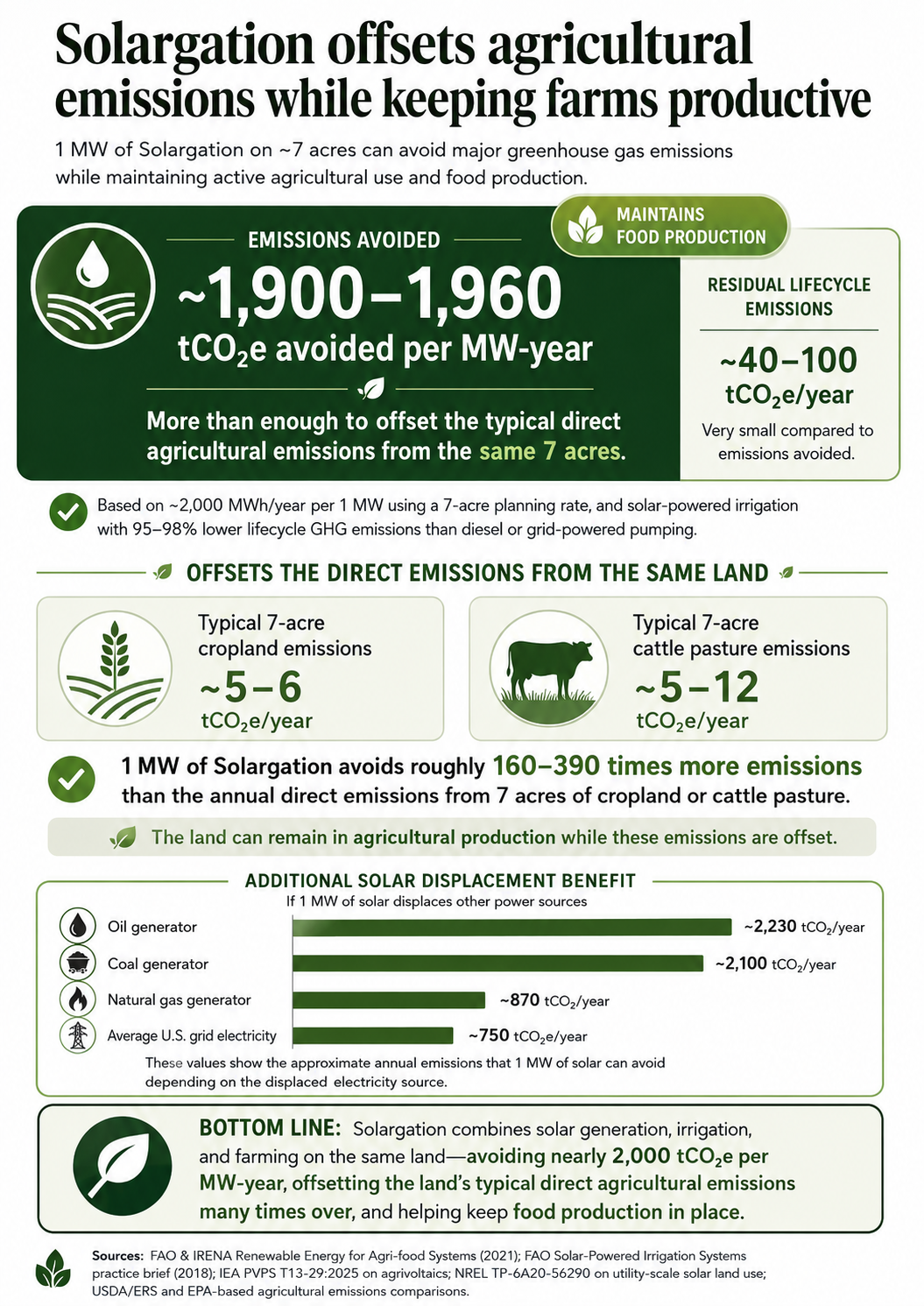
Emissions avoided from 1 MW of Solargation®
~1,900–1,960tCO₂e avoided per MW-year
Based on approximately 2,000 MWh/year per 1 MW using a 7-acre planning rate, with Solargation® supporting irrigation and displacing higher-emission power sources.
Solargation® combines solar generation, fixed-set irrigation, and active farming on the same land so farms can keep producing food while the energy system avoids greenhouse gas emissions.
The simple emissions story is that the land remains productive, but the solar generation can avoid far more greenhouse gas emissions than the land typically emits through direct agricultural activity.
Based on approximately 2,000 MWh/year per 1 MW using a 7-acre planning rate, with Solargation® supporting irrigation and displacing higher-emission power sources.
tCO₂e/year estimated residual lifecycle emissions, which are small compared with the emissions avoided.
tCO₂e/year of direct agricultural emissions.
tCO₂e/year of direct agricultural emissions.
more avoided emissions than the same land’s typical direct annual agricultural emissions.
Land remains in active agricultural use with crops, pasture, irrigation, and farmer access planned around the solar layout.
Solar generation on the same land avoids emissions from fossil-fuel generation and supports farm energy resilience.
The integrated irrigation platform can reduce reliance on diesel or grid-powered pumping while supporting agricultural productivity.
When 1 MW of solar generation displaces higher-emission electricity, the annual avoided emissions can be substantial.

By combining solar generation, irrigation, and farming on the same acreage, Solargation® can avoid nearly 2,000 tCO₂e per MW-year while helping keep food production in place.
Sources: FAO & IRENA Renewable Energy for Agri-food Systems; FAO Solar-Powered Irrigation Systems practice brief; IEA PVPS agrivoltaics materials; NREL utility-scale solar land-use analysis; USDA/ERS and EPA-based agricultural emissions comparisons.
Planning assumptions: 1 MW of Solargation® on approximately 7 acres; approximately 2,000 MWh/year per MW; emissions avoided vary with displaced electricity source and local grid conditions.
Back to top